
Stainless Steel Pipeline Corrosion: Pitting, Crevice, MIC, SCC & Material Solutions
Published: 2026-07-20 Views: 86
Understanding corrosion mechanisms and selecting the right stainless steel grade for corrosive service environments
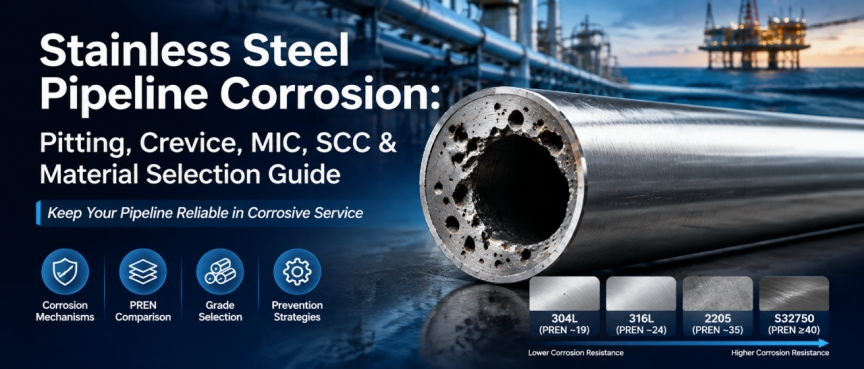
Why Stainless Steel Pipes Corrode
Stainless steel owes its corrosion resistance to a thin, self-healing chromium-rich oxide layer that forms naturally on the surface. Yet in industrial pipeline systems — particularly those handling seawater, chloride-bearing chemicals, or sour hydrocarbons — this passive layer can break down locally, leading to costly and sometimes catastrophic failures. For procurement engineers and stockists, understanding the primary corrosion mechanisms is the first step toward specifying the right material grade.
Four Common Corrosion Types in Pipeline Systems
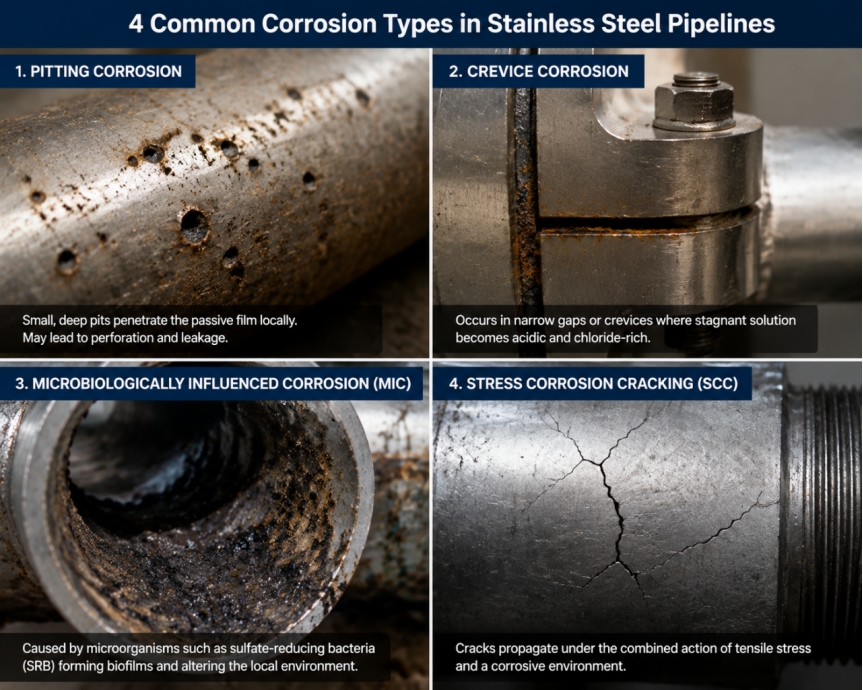
1. Pitting Corrosion
Pitting occurs when chloride ions locally penetrate the passive film, creating small cavities that can perforate a pipe wall within months. The pit entrance may be barely visible, while a network of material loss lurks beneath the surface — making it one of the most insidious and dangerous forms of attack. Higher chromium, molybdenum, and nitrogen content directly improve pitting resistance.
2. Crevice Corrosion
Crevice corrosion initiates in narrow gaps — under gaskets, at flange faces, inside threaded joints, or beneath deposits. Stagnant, oxygen-depleted electrolyte inside the crevice becomes acidic and chloride-enriched, accelerating metal dissolution. It is the most common failure mode in seawater-cooled heat exchangers and bolted flange connections.
3. Microbiologically Influenced Corrosion (MIC)
MIC is caused by biofilms of bacteria, archaea, or fungi that alter the local chemistry at the metal surface. Sulfate-reducing bacteria (SRB) are particularly problematic in oilfield water handling and subsea systems, producing hydrogen sulfide that accelerates both pitting and cracking. MIC can involve multiple microorganisms including sulfate-reducing bacteria (SRB), acid-producing bacteria (APB), and iron-oxidizing bacteria. Regular cleaning, biocide treatment, and smooth surface finishes help mitigate MIC risk.
4. Stress Corrosion Cracking (SCC)
SCC requires three simultaneous conditions: a susceptible material, tensile stress, and a corrosive environment. Austenitic stainless steels such as 304 and 316/316L may become susceptible to chloride stress corrosion cracking (Cl-SCC) under combinations of elevated temperature, tensile stress, and chloride exposure, typically becoming a concern above approximately 60°C depending on service conditions. Duplex and super duplex grades offer significantly better SCC resistance due to their balanced ferrite-austenite microstructure.
The PREN Factor: Ranking Material Resistance
The Pitting Resistance Equivalent Number (PREN) is the industry-standard formula for comparing localized corrosion resistance across grades:
1) PREN = %Cr + 3.3 × (%Mo + 0.5×%W) + 16 × %N (S32760)
2) PREN = Cr + 3.3Mo + 16N (S32750)
Grade | UNS | Typical PREN | Corrosion Environment |
304 / 304L | S30400 / S30403 | ~19 | Mild, low-chloride, atmospheric |
316 / 316L | S31600 / S31603 | ~24 | Moderate chloride, chemical processing |
2205(Duplex) | S31803 / S32205 | ~35 | Seawater, pulp & paper, oil & gas |
S32750 (Super Duplex) | S32750 | ≥ 41 | Subsea, deepwater, high-chloride, sour service |
904L | N08904 | ~37 | Sulfuric acid, phosphoric acid, desalination |
Stainless Steel Grade Selection Guide
· Atmospheric and low-chloride service: 304/304L is generally sufficient and cost-effective.
· Moderate chloride and chemical processing: 316/316L remains the workhorse grade.
· Seawater, brackish water, and oilfield produced water: duplex 2205 or super duplex S32750.
· Subsea flowlines, risers, and seawater injection: UNS S32750 and S32760 super duplex stainless steels are widely used for PREN 40+ applications such as subsea systems, seawater injection, and offshore piping. 904L is commonly selected for sulfuric acid, phosphoric acid, and chloride-containing chemical environments, while more severe acid conditions may require nickel-based alloys.
How to Prevent Stainless Steel Pipe Corrosion
· Select a grade with adequate PREN for the operating chloride concentration and temperature.
· Eliminate crevices in design — avoid sharp corners, stagnant zones, and poorly sealed gaps.
· Specify smooth surface finishes (pickled and passivated) to reduce biofilm adhesion.
· Control water chemistry — minimize chloride concentration, maintain pH, and use biocides where appropriate.
· Apply cathodic protection for submerged or buried structures.
· Implement regular inspection and maintenance programs to detect early-stage attack.
Need help selecting stainless steel pipe grades for seawater, chemical, or oil & gas applications? Zhuoli Pipeline provides ASTM-compliant stainless steel, duplex, and nickel alloy piping solutions with full MTC documentation. Contact us NOW: commercial@zhuoli-pipeline.com .