
S32750 (2507) Super Duplex Stainless Steel : Properties, PREN Value, and Offshore Pipeline Applications
Published: 2026-08-01 Views: 113
Why super duplex S32750 is the material of choice for extreme offshore and seawater service
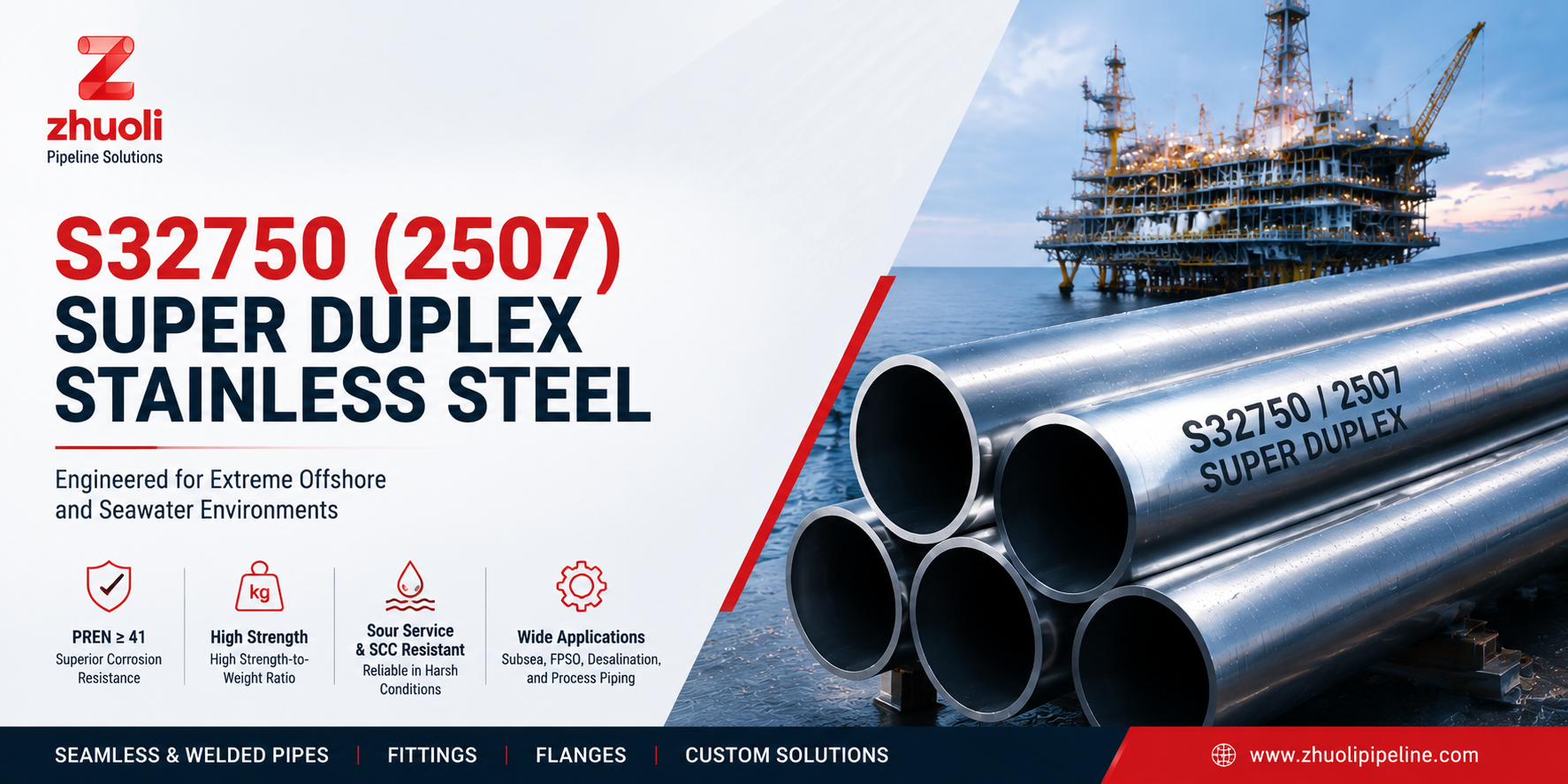
What is What is S32750 Super Duplex Stainless Steel?
In the hierarchy of corrosion-resistant alloys, super duplex stainless steel UNS S32750 — also known as 2507 or EN 1.4410 — occupies an important position between conventional austenitic stainless steels and nickel-based alloys, offering a balance of corrosion resistance, mechanical strength, and cost efficiency. A PREN value above 40 is commonly associated with super duplex grades selected for severe chloride environments, including seawater systems and subsea applications.
Chemical Composition and PREN
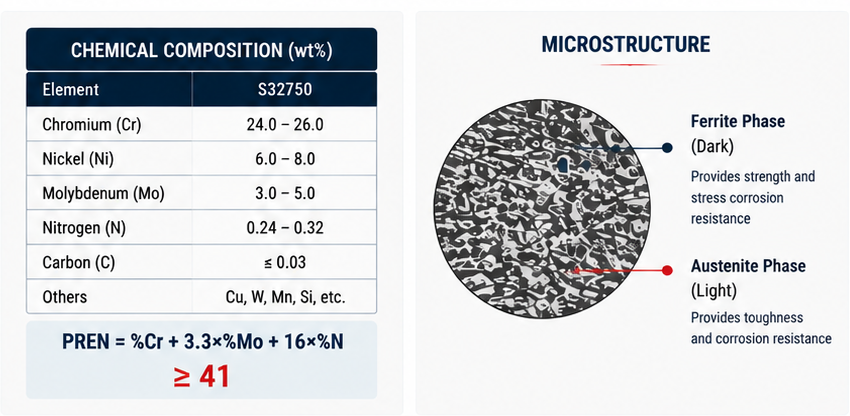
S32750 is a super duplex grade with a balanced chemistry of approximately 25% chromium, 7% nickel, 4% molybdenum, and 0.27% nitrogen. The high nitrogen content not only boosts pitting resistance but also stabilizes the austenite phase and increases strength. Its typical PREN of 42–43 places it well above the PREN 40 threshold commonly required for subsea and seawater service. Typical composition ranges are defined by specifications such as ASTM A182 and ASTM A790.
Element | S32750 (wt%) | Role |
Chromium (Cr) | 24.0 – 26.0 | Passive film formation, corrosion resistance |
Nickel (Ni) | 6.0 – 8.0 | Austenite stabilization, toughness |
Molybdenum (Mo) | 3.0 – 5.0 | Pitting and crevice corrosion resistance |
Nitrogen (N) | 0.24 – 0.32 | PREN boost, strength, austenite stabilization |
Carbon (C) | ≤ 0.03 | Low carbon for weld integrity |
Key Mechanical Properties of UNS S32750
· Yield strength: ≥ 550 MPa (The yield strength is approximately twice that of conventional 316L stainless steel, enabling weight reduction in pressure-containing components.)
· Tensile strength: ≥ 800 MPa
· Elongation: ≥ 25%
· Hardness: ≤ 32 HRC
The high strength-to-weight ratio allows engineers to specify thinner wall sections, reducing both material cost and system weight — a significant advantage in offshore and subsea applications.
Why S32750 for Offshore Service?
Superior Localized Corrosion Resistance
Offshore seawater environments typically contain chloride levels around 19,000 ppm, with higher concentrations possible in concentrated seawater systems. S32750's PREN of 41+ ensures resistance to pitting and crevice corrosion far beyond the capabilities of 316L (PREN ~24) or even standard duplex 2205 (PREN ~35).
Sour Service Compatibility
Many offshore reservoirs produce sour crude containing hydrogen sulfide (H₂S). Properly manufactured and qualified S32750 components can provide resistance to sulfide stress cracking (SSC) and may be selected for sour-service applications according to NACE MR0175 / ISO 15156 requirements.
Stress Corrosion Cracking Resistance
Compared with austenitic grades such as 304 and 316, super duplex stainless steel generally provides improved resistance to chloride stress corrosion cracking due to its duplex microstructure.
Applications
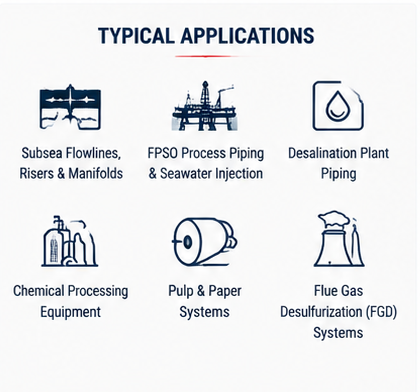
Primary Applications
· Subsea flowlines
· Risers
· Manifolds
· FPSO piping
· Seawater injection
Other Applications
· Desalination
· Chemical processing
· Pulp and paper
· FGD systems
Fabrication & Welding Considerations
S32750 requires careful fabrication to preserve its balanced microstructure and corrosion resistance:
· Hot forming should be performed within the range of 1020–1120°C, followed by rapid cooling.
· Welding procedures should maintain phase balance with approximately 35–65% ferrite.
· Post-weld heat treatment is normally not required and may negatively affect corrosion performance if improperly applied.
· Cold working should be limited to avoid excessive ferrite deformation and loss of toughness.
· Pickling and passivation after fabrication restore the passive chromium oxide layer.
S32750 Market Demand in Offshore Energy
The global super duplex market continues to grow, driven by deepwater oil and gas expansion in Brazil, the Gulf of Mexico, and West Africa, as well as desalination capacity additions in the Middle East. Many deepwater FPSO and subsea developments specify super duplex stainless steel for selected corrosion-critical piping systems. Projects such as Petrobras’ Búzios and SEAP developments demonstrate continued demand for corrosion-resistant materials in Brazilian offshore operations. While the upfront material cost is higher than 316L or 2205, the reduction in wall thickness, extended service life, and lower maintenance costs deliver superior total lifecycle economics in harsh environments.
Zhuoli Pipeline supplies S32750 super duplex seamless and welded pipes, buttweld fittings, and flanges to ASTM A790, A815, and ASME B16.5 standards. Contact us NOW: commercial@zhuoli-pipeline.com .